
Perceptual Entry / Perceptual Exit
A Working Research Tool for Slowing Interpretation in Artistic Practice
Research Tool v0.2
Chen Ye
2026
https://chenye.me/research-tool
A working research tool developed alongside artistic practice.
Why this tool exists
The problem this tool addresses
This tool was developed from a recurring problem within my own artistic practice: the moment when a work begins to be understood too quickly before the perceptual process has fully unfolded.
In this situation, a work may become stabilized through naming, explanation, thematic framing, visual completion, or interpretive judgment. The question is not whether language, interpretation, or contextual framing should be rejected. Rather, the question is how artistic practice can create conditions in which perception remains active for longer within the process of making.
This tool therefore focuses on a practical and operational problem within practice: how to recognize when bodily perception is activated through material resistance, hesitation in action, waiting, covering, withdrawal, and decisions in making; and when it withdraws into explanation, categorization, or premature completion.
What this tool offers
This document does not propose an artwork, a portfolio, or a finished theory.
It does not make therapeutic, psychological, or wellness claims.
Instead, it functions as a decision and judgment tool -
designed primarily for studio practice: to slow down premature interpretation and to clarify when bodily and perceptual attention is operative in making, and when it has withdrawn.
Within my ongoing practice-based research, this tool observes how material conditions, bodily actions, and judgments in making affect the generation of a work. Viewing actions are used only as supplementary indicators of whether perceptual tension is sustained.
One-line research question
How does bodily perception enter, withdraw, and re-enter the generation of a work through material conditions, pauses in making, covering, withdrawal, and decisions in making, and how can viewing delay serve as a supplementary indicator of sustained perceptual tension?
Core terms
This tool operates through a single pair of terms.
They are not metaphors or psychological states, but operational positions within artistic practice. They are primarily used to examine the making process; viewing is considered only as a supplementary field of observation, not as a required outcome.
Perceptual Entry
Definition
Perceptual Entry refers to moments when bodily attention is actively engaged within making, prior to stable naming, explanation, or visual resolution. In viewing, it may appear only as a supplementary indicator through delayed naming, staying with the work, or renewed looking.
Perceptual Entry is not:
Not emotional immersion
It does not require intensity, empathy, or affective identification.
Not interpretation
It does not depend on knowing what the work “means”.
Not intention
It does not presuppose a clear artistic aim or conceptual control.
Perceptual Exit
Definition
Perceptual Exit refers to moments when bodily attention withdraws and is replaced too quickly by categorization, explanation, interpretive judgment, or a sense of visual completion.
Perceptual Exit is not:
Not failure
Exit is a structural condition, not an error to be corrected.
Not distraction
It is not caused by lack of focus or external interruption.
Not thinking as such
Exit occurs when thinking replaces perceptual negotiation too quickly.
Self-test & decision moves
This section translates the terms into usable criteria.
They are not prescriptions, but tools for decisions in making. Some criteria may also help read viewing feedback as supplementary material, but they are not meant to prescribe viewer responses.
The following criteria are not diagnostic, but heuristic.
Self-test: Has Perceptual Exit occurred?
Perceptual Exit is likely present when two or more of the following conditions coincide:
A. The work can be named, categorized, or summarized without further negotiation.
B. Decisions proceed smoothly, predictably, and without resistance.
C. A sense of completion, coherence, or “this already works” dominates the process.
Exit is not something to avoid entirely—but something to recognize.
Decision moves: What to do when Exit dominates
The following actions function as practical decision tools, not stylistic effects.
Work through material conditions
Use resistance, particles, covering, drying, waiting, friction, or other material conditions to slow action and prevent full foresight of results.
Delay naming
Postpone titles, explanations, or thematic framing, or leave them unresolved.
Interrupt completion
Stop working at moments of visual coherence or satisfaction rather than refining.
Withdraw the guiding gesture
Reduce intervention when the work begins to direct interpretation too clearly.
Return without correction
Re-enter the work without fixing or clarifying unresolved states.
These moves are primarily studio-based. Viewer responses are not required or predetermined; where considered, they function only as supplementary indicators for whether perceptual tension is sustained or prematurely stabilized.
Evidence from practice
The following examples indicate how the tool has been tested within selected works. They are not intended as full artwork analyses, but as evidence of how Perceptual Entry and Perceptual Exit can operate as practical criteria within the making process.
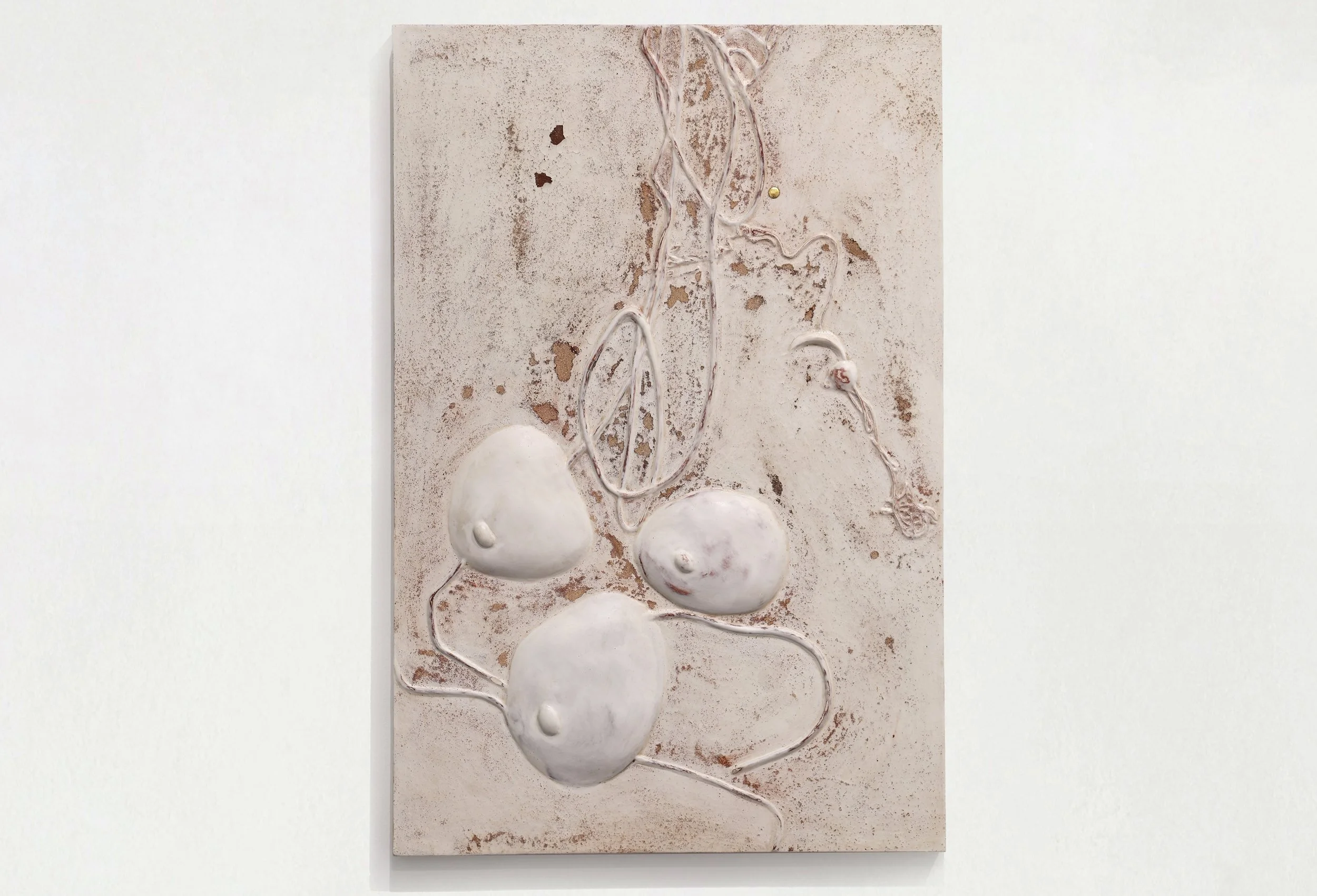
Work 1 — Contact
2025, mixed media on wood panel
(Marble powder (varied grain sizes), chalk powder, sand, rabbit skin glue, putty powder)
This section presents a set of operational conceptual tools developed alongside artistic practice, intended to slow down premature interpretation of experience.
It is neither an artwork nor a finished theoretical outcome, but a working decision-support tool for making and viewing.
The current version is v0.2 and remains subject to ongoing revision through practice.
Where Exit occurred
Perceptual Exit was identified at the point when the overall relief structure had been established and attention shifted toward surface finishing and visual refinement.
What decision was made
Instead of completing the surface through smoothing or decorative resolution, I stopped the process and introduced material conditions that increased resistance, unpredictability, and tactile variation.
What changed after intervention
Working with marble powder of varied grain sizes, chalk powder, sand, rabbit skin glue, and putty powder altered the pace of making. Grinding and sanding became uneven and physically demanding, reintroducing bodily negotiation through pressure, friction, and fatigue.
What this demonstrates
This work demonstrates how material conditions can interrupt a shift toward visual optimization and re-open perceptual engagement when Exit is recognized.
Work 2 — Interface
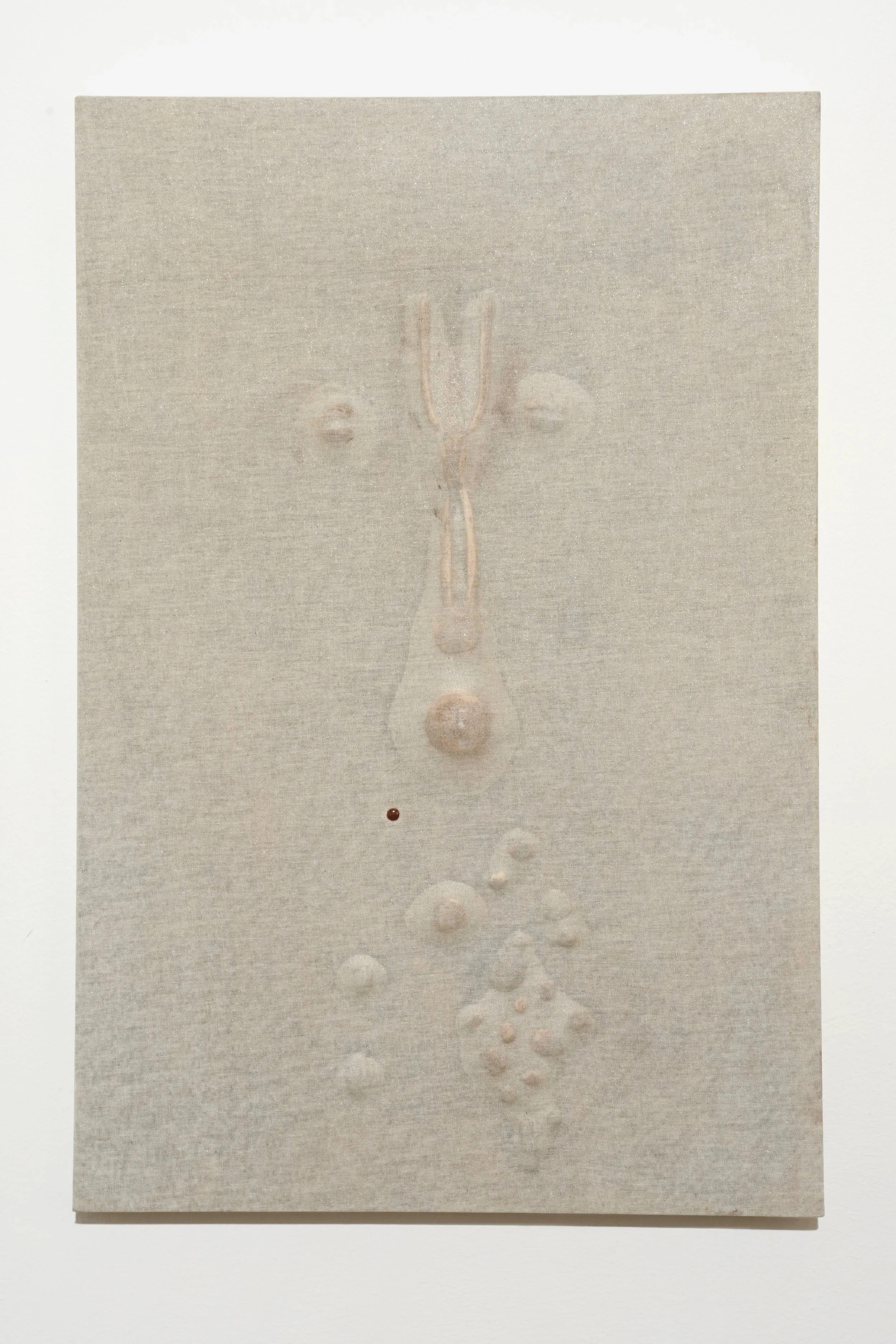
2025, mixed media on canvas
(putty powder, cotton fabric, rabbit skin glue)
Where Exit occurred
Exit emerged at the moment when the underlying relief suggested a clear next step: adding color blocks according to a preparatory sketch, which would have made the work more immediately legible as emotional or expressive content.
What decision was made
I chose to abandon the sketch and suspend color application, proceeding instead with covering the surface using a thin layer of cotton fabric without further pictorial intervention.
What changed after intervention
The fabric partially concealed the relief beneath, creating a tension between softness and rigidity, exposure and concealment. The work shifted from expressive description toward a sustained perceptual ambiguity.
What this demonstrates
This work demonstrates how withdrawing an intended expressive gesture can prevent premature interpretation and allow bodily perception to remain operative without explanatory reinforcement.
Tool status
This is a working research tool developed in parallel with artistic practice.
It does not propose a finished theory, but a set of operational terms and decision criteria tested primarily through making. Viewing feedback, where used, remains supplementary material rather than psychological or social-scientific data. The tool remains subject to revision through further practice-based evidence.
How to cite
Short citation
Chen Ye, Perceptual Entry / Perceptual Exit — Research Tool v0.2, 2026.
https://chenye.me/research-tool
Full citation
Chen Ye. Perceptual Entry / Perceptual Exit: A Working Research Tool for Slowing Interpretation in Artistic Practice.
Version 0.2, 2026.
Available at: https://chenye.me/research-tool
Versions
v0.2 — 2026 — Revised working version
v0.1 — 2026-01-15 — Initial release